
Sequences
A schema's Sequences tab (/db/<database>/schema/<schema>/sequences) lists the schema's sequences and opens the sequence editor. phpMyAdmin has no counterpart: MySQL's AUTO_INCREMENT is a column attribute, while PostgreSQL keeps the counter in a separate sequence object. In the navigation panel, sequences sit under Sequences; clicking one opens its editor.
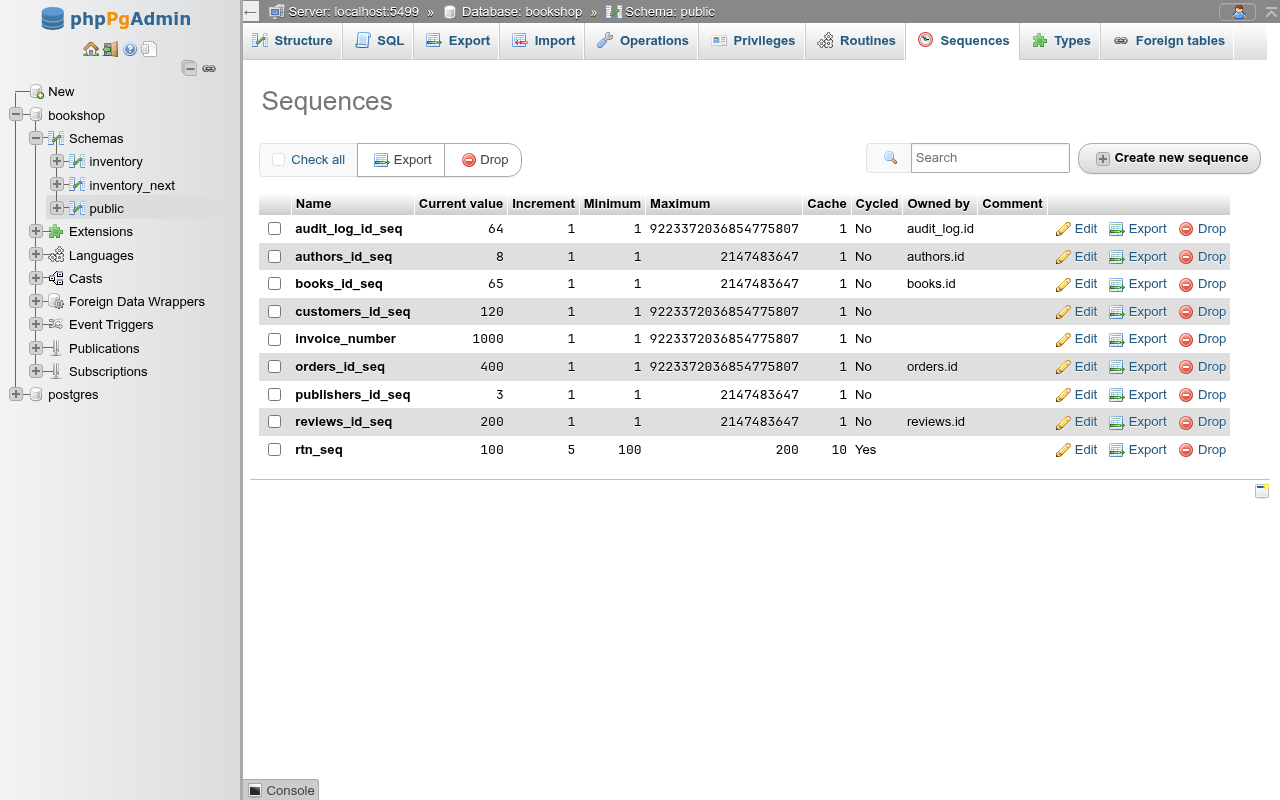
The sequence list
The columns are Name, Current value, Increment, Minimum, Maximum, Cache, Cycled, Owned by (the table.column the sequence belongs to) and Comment, with Edit, Privileges, Export and Drop per row (Privileges opens the editor at its privileges). Above the table: Check all with bulk Export and Drop, the filter box (matches the name as you type) and Create new sequence.
Sequences behind serial and identity columns are listed too, for example books_id_seq owned by books.id.
The list and the editor show bigint values in full, for example the default maximum 9223372036854775807 of a bigint sequence.
Create a sequence
Create new sequence opens …/sequences/create. Empty fields use PostgreSQL's defaults.
| Field | What it does | SQL |
|---|---|---|
| Sequence name | The name. | CREATE SEQUENCE public.rtn_seq |
| Owner | (current role) or a role. | ALTER SEQUENCE … OWNER TO |
| Comment | COMMENT ON SEQUENCE | |
| Data type | smallint, integer or bigint (the default); it bounds the minimum and maximum. bigint is not written, as pg_dump leaves it out. | AS integer |
| Increment | Step between values; negative counts down. Default 1. | INCREMENT 5 |
| Start | First value returned. Default: the minimum (ascending) or maximum (descending). | START 100 |
| Minimum / Maximum | Bounds. Defaults: 1 and 2⁶³−1 for an ascending bigint sequence. | MINVALUE 100 / MAXVALUE 200 |
| Cache | How many values each session reserves at a time. Default 1. | CACHE 10 |
| Cycled | Wrap around to the other bound instead of failing at the end. | CYCLE / NO CYCLE |
| Unlogged | Not WAL-logged: faster, but reset after a crash and not replicated (PostgreSQL 15+). | CREATE UNLOGGED SEQUENCE / SET UNLOGGED |
| Owned by | A table of this schema, then one of its columns. The sequence is dropped with that column or table. (none) removes the link. | ALTER SEQUENCE … OWNED BY public.books.pages |
Preview SQL shows the statements, Go creates the sequence and returns to the list with Sequence … has been created. For example:
CREATE SEQUENCE public.rtn_seq
    CYCLE
    INCREMENT 5
    START 100
    MINVALUE 100
    MAXVALUE 200
    CACHE 10;
The hint under Owned by reads A sequence owned by a column is dropped with it; the table must be in this schema.
Not in the form
- RESTART: there is no Restart field; use Current value or
ALTER SEQUENCE … RESTART WITH n. - To use a sequence as a column default, set the column's default to
nextval('rtn_seq')on the table's Structure tab, or use an identity column.
Edit a sequence
Edit (or clicking the sequence in the navigation panel) opens …/sequences/<name>/edit. The form has the same fields, except Start, which is replaced by Current value. Changes run as ALTER SEQUENCE statements: RENAME TO for the name, OWNER TO, OWNED BY, SET UNLOGGED / SET LOGGED, COMMENT ON SEQUENCE, and one ALTER SEQUENCE with the changed AS type, INCREMENT, MINVALUE, MAXVALUE, CACHE and CYCLE settings. A new type moves bounds that were the old type's defaults to the new type's (PostgreSQL does it); a value outside the new type's range is refused.
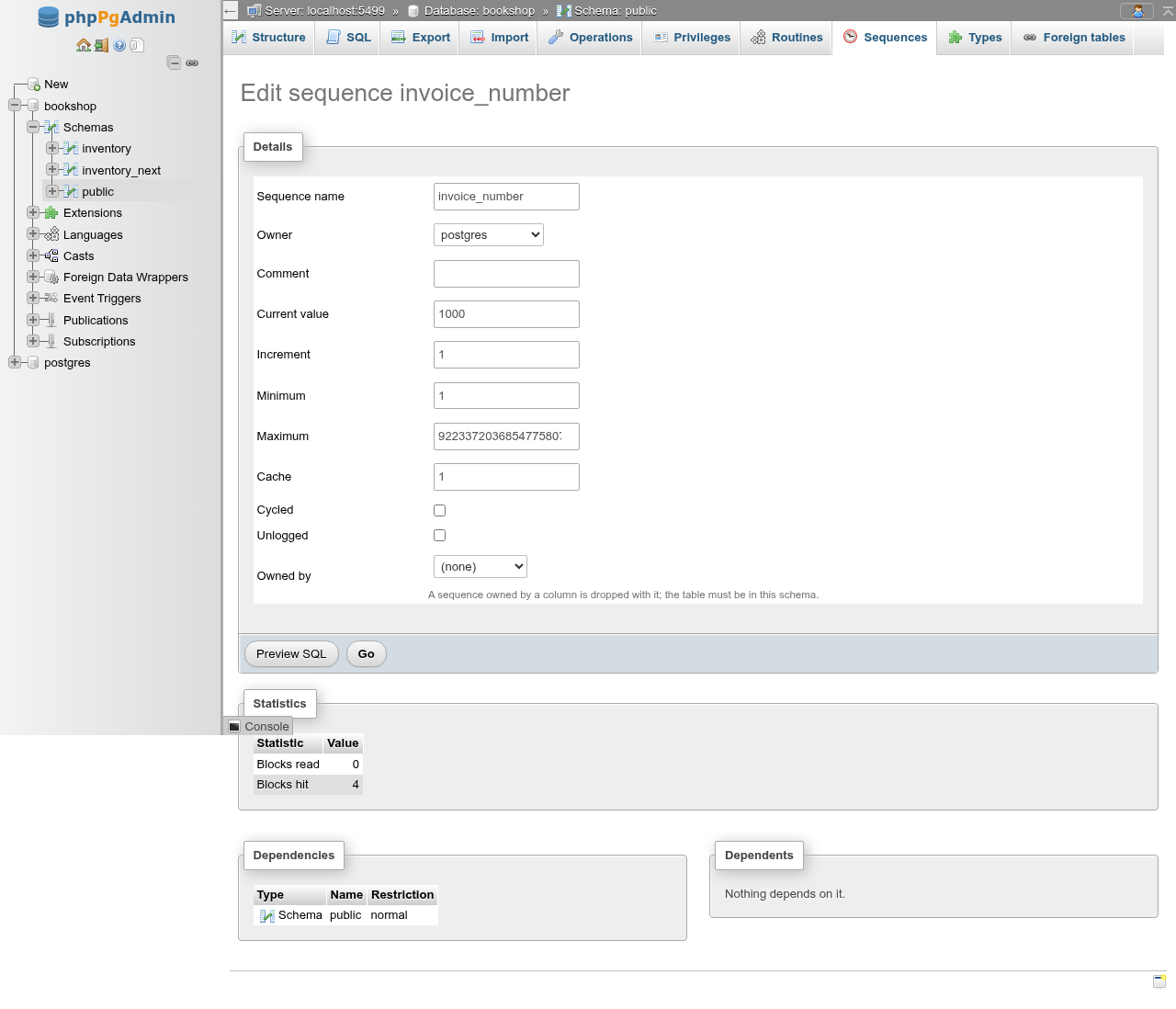
Only the fields you changed are sent as clauses: a bound you leave alone is not repeated in the ALTER SEQUENCE.
Current value
Current value shows the sequence's last_value. Changing it runs setval with false, so the next nextval() returns exactly the number you typed:
SELECT setval('public.rtn_seq', 150, false);Why the current value can be ahead
With Cache above 1, each session that calls nextval() reserves a block of values, and last_value records the end of that block. After two nextval() calls on a sequence with increment 5 and cache 10 that returned 100 and 105, Current value shows 145. Values reserved by sessions and never used are skipped: sequences are not gap-free, and a rolled-back transaction does not give its value back either.
Restart and next value
Below the form, the Actions card has the classic phpPgAdmin's sequence actions:
- Restart runs
ALTER SEQUENCE … RESTART, at the value in Restart at, or at the start value when the field is empty. The nextnextval()returns that value. - Next value calls
nextval()once and shows the value it returned. Like anynextval(), the value is used up even though nothing stores it.
The Schema select of an existing sequence moves it with ALTER SEQUENCE … SET SCHEMA.
Privileges
Below the form, the sequence's grantees as on the Privileges tabs: each role with its privileges (USAGE, SELECT, UPDATE), Edit privileges and Revoke, and Add privileges for a role under New:
GRANT USAGE ON SEQUENCE public.rtn_seq TO bookshop_staff;Statistics, Dependencies and Dependents
Below the privileges: Statistics (Blocks read and Blocks hit from pg_statio_all_sequences), Dependencies (the schema; the owning column) and Dependents (column defaults that call nextval on it, listed as Function nextval('rtn_seq'::regclass)).
Export and drop
Export shows the CREATE SEQUENCE statement with its owner, comment and grants, and Copy to clipboard. It does not include the current value; add SELECT setval('public.rtn_seq', …); yourself when copying a sequence to another database. For data and sequence values together, use Export.
Drop shows DROP SEQUENCE "public"."rtn_seq"; with Also the objects that depend on it (CASCADE). Without CASCADE, a sequence used in a column default fails with cannot drop sequence rtn_seq because other objects depend on it; with it, the defaults are removed and the columns stay. A sequence owned by a column is dropped automatically when that column or its table is dropped.
Identity columns
A sequence behind an IDENTITY column is managed through the column. Change its options with ALTER TABLE … ALTER COLUMN … SET INCREMENT BY … or RESTART; dropping it directly is refused.